
Products / NPMEDU.ai

NPMEDU.ai

Learn to judge the evidence, not just recall it.

NPMEDU.ai is the medical and life sciences teaching and learning platform from EvidenceReady Academy, part of Cadenome.ai. It is designed for institutions, faculty, educators, and students who want more than a general-purpose AI chatbot: they want AI embedded in structured educational workflows, connected to source-based evidence, governed by academic rules, and kept under human and faculty control.

From EvidenceReady Academy Education only No patient data Human reviewed
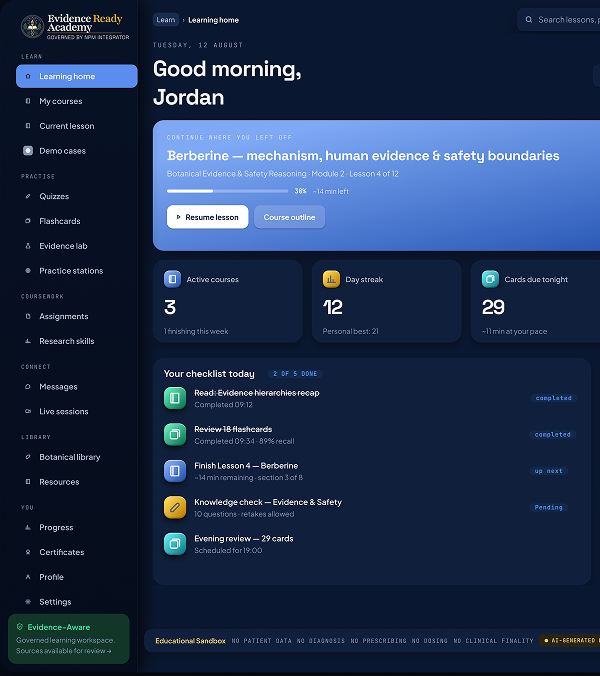
NPMEDU.ai learning dashboard

What it is

Depth where general chatbots stay shallow.

NPMEDU.ai focuses on postgraduate and advanced learning across medical and life sciences, including evidence appraisal, biomedical mechanisms, pharmacology and PK/PD literacy, botanical medicine and pharmacognosy, clinical nutrition, research methods, safety reasoning, regulatory-claims literacy, responsible AI use, case simulation, curriculum development, and assessment design.

Its controlled educational reasoning framework is designed to separate human evidence, preclinical findings, mechanisms, traditional knowledge, regulatory information, uncertainty, and unsupported claims rather than presenting every AI-generated statement with the same level of confidence.

Controlled educational reasoning framework

Every statement is placed on a ladder of evidence — not flattened into one confident voice.

01
Human evidenceClinical trials and studies in people.
02
Preclinical findingsIn-vitro and animal data, labelled as such.
03
MechanismsBiological plausibility, not proof of effect.
04
Traditional knowledgeHistorical and ethnobotanical use.
05
Regulatory informationWhat is permitted, approved, or restricted.
06
UncertaintyWhere the evidence is thin or conflicting.
07
Unsupported claimsFlagged, never presented as fact.

Education first

The platform is education-first. It is not designed to diagnose, prescribe, determine individualized doses, change medications, generate patient-specific treatment plans, or replace qualified professional judgment. Ordinary educational workflows are designed around fictional, synthetic, or appropriately de-identified cases rather than identifiable patient information.

Three portals, one platform

Teachers build. Students learn. Institutions govern.

Each portal is a different view of the same governed platform — not three products.

Portal 01

Teacher Portal

AI Shaped by the Educator

The Teacher Portal is designed to give educators a workspace for building courses, lessons, lectures, cases, assessments, and reusable learning assets while retaining control over how the AI teaches.

The goal is not to replace the teacher with AI, but to let faculty shape AI into an extension of their educational intent.

  • Teaching persona
  • Curriculum assets
  • Botanical Plates
  • Evidence Ladders
  • Question banks
  • Rubrics and remediation
Portal 02

Student Portal

Extend Learning Without Outsourcing Thinking

The Student Portal is designed for learners who want to go beyond assigned course material, explore difficult concepts, test their understanding, and continue developing knowledge outside scheduled class time.

A central design principle is that AI should support thinking without removing the thinking.

  • Evidence ladders
  • Mechanism explanations
  • Paper deconstruction
  • Simulated cases
  • Safety-flag exercises
  • Guided remediation
Portal 03

Institutional Portal

Build Governed Curricula Not Isolated AI Activities

For universities, professional schools, departments, continuing-education organizations, and other learning institutions, NPMEDU.ai is designed to support curriculum development at a broader level.

That distinction matters.

  • Programme architecture
  • Approved sources
  • Assessment methods
  • Faculty review
  • AI-use expectations
  • Release of materials
Portal 01

The Teacher Portal

AI Shaped by the Educator

The Teacher Portal is designed to give educators a workspace for building courses, lessons, lectures, cases, assessments, and reusable learning assets while retaining control over how the AI teaches.

Teaching persona

Faculty can develop a teaching persona that reflects their preferred instructional approach: learner level, tone, terminology, degree of Socratic questioning, evidence expectations, scaffolding strategy, assessment style, and the amount of support learners receive. The goal is not to replace the teacher with AI, but to let faculty shape AI into an extension of their educational intent.

Curriculum assets

Within the portal, educators can develop learning objectives, lecture and seminar structures, fictional case simulations, evidence-appraisal exercises, mechanism maps, question banks, quizzes, answer rationales, rubrics, remediation activities, instructor notes, Botanical Plates, Evidence Ladders, and other curriculum assets. The NPMEDU.ai curriculum model also supports faculty-ready packages and LMS-oriented educational materials.

Assessment

Assessment is treated as part of the learning design rather than simply automated question generation. NPMEDU.ai can structure pre-tests, post-tests, MCQs, case-based assessments, rationales, remediation pathways, competency maps, and educational badges or Certificates of Completion, while preserving the boundary between educational achievement and clinical credentialing or licensure.

Portal 02

The Student Portal

Extend Learning Without Outsourcing Thinking

The Student Portal is designed for learners who want to go beyond assigned course material, explore difficult concepts, test their understanding, and continue developing knowledge outside scheduled class time.

Students can work with evidence ladders, mechanism explanations, research-paper deconstruction, scientific reasoning exercises, simulated cases, flashcards, knowledge checks, safety-flag exercises, regulatory-claims challenges, and guided remediation. NPMEDU.ai’s mode architecture is designed to support different learning tasks rather than treating every interaction as the same kind of chatbot conversation.

A central design principle is that AI should support thinking without removing the thinking.

Instructional scaffolding with productive struggle

NPMEDU.ai therefore combines instructional scaffolding with productive struggle. Instead of immediately supplying a polished final answer, a learning activity can require the student to make an initial interpretation, identify a mechanism, critique evidence, or propose a reasoning path. The system can then diagnose the missing step, provide the smallest useful hint or evidence cue, require revision, and reveal progressively more explanation as the activity continues.

Common scaffolds

Common scaffolds can include worked examples early in learning, guiding questions, checklists, rubrics, prompts, concept cues, progressively revealed evidence, targeted feedback after an attempt, and support that changes according to demonstrated learner performance.

Scaffolded productive struggle

The learner commits first. The AI helps second.

The intended learning sequence is simple: present an authentic problem at an appropriate difficulty level; require the learner to commit to an answer or interpretation; allow an initial attempt without the AI supplying the final answer; identify the misconception or missing step; provide the smallest useful hint; require revision; reveal explanation and source-visible evidence when appropriate; and then gradually fade AI assistance so the learner must demonstrate the skill independently.

AI assistance Learner independence
01

present an authentic problem

02

require the learner to commit

03

allow an initial attempt

04

identify the misconception

05

provide the smallest useful hint

06

require revision

07

reveal explanation and source-visible evidence

08

gradually fade AI assistance

The aim is for NPMEDU.ai to function as a learning partner and reasoning scaffold, not an answer machine.

Portal 03

The Institutional Portal

Build Governed Curricula Not Isolated AI Activities

For universities, professional schools, departments, continuing-education organizations, and other learning institutions, NPMEDU.ai is designed to support curriculum development at a broader level.

Programme architecture

Institutions can structure an entire educational pathway—from individual learning objectives and lessons to multi-week modules, assessments, faculty materials, remediation pathways, capstones, and program-level curriculum architecture. Existing NPMEDU.ai curriculum models include introductory pilots, applied multi-week programs, and semester-scale curriculum structures spanning AI literacy, evidence appraisal, pharmacognosy, mechanisms, safety, regulatory claims, research literacy, and case-based reasoning.

Institutional rules

This enables an institution to establish its own educational rules around learner level, evidence requirements, approved sources, assessment methods, faculty review, AI-use expectations, privacy, and release of learning materials rather than asking each student or instructor to independently manage a general-purpose chatbot.

That distinction matters.

Generic tutoring, content drafting, summarization, and faculty-productivity features are increasingly becoming standard AI capabilities. EvidenceReady Academy’s differentiated direction for NPMEDU.ai is therefore not simply “AI that can write a course.” It is the combination of medical and life sciences specialization, evidence controls, educational governance, assessment safeguards, source traceability, privacy boundaries, faculty authority, and controlled learning workflows.

Governance

Governed AI Rather Than a General Purpose Chatbot

NPMEDU.ai is designed around the idea that health-sciences education requires stronger controls than ordinary conversational AI.

Its educational reasoning framework uses explicit intent, risk, evidence, and output-quality gates. Material claims can be separated by evidence type and strength, mechanisms can be kept distinct from demonstrated human outcomes, AI-generated hypotheses can be labeled rather than presented as established knowledge, and high-risk subjects can be routed toward safety-focused education and appropriate human review.

The learning artifact contract

The broader EvidenceReady governance architecture further defines a model in which substantive educational work can move through a Learning Artifact Contract, risk and verification classification, source planning, claim-to-source mapping, validation, human review, controlled release states, and provenance records.

01

Learning Artifact Contract

02

Risk and verification classification

03

Source planning

04

Claim-to-source mapping

05

Validation

06

Human review

07

Controlled release states

08

Provenance records

Stated honestly

Proposed is not validated.

Importantly, the current governance specification itself describes these expanded controls as a recommended implementation and cautions against presenting proposed or designed capabilities as validated, accredited, compliant, or production-proven without dated evidence.

That principle is central to EvidenceReady Academy: AI output should be reviewable, evidence-aware, and accountable to human educational authority.

The EvidenceReady difference

Not simply

“What can AI generate?”

But

“How should AI participate in serious medical and life sciences education when evidence quality, learner independence, safety, faculty authority, assessment integrity, and institutional accountability matter?”

The result is an education-first platform designed to help teachers build, students learn, and institutions govern—while keeping the human educator at the center.

Scope

NPMEDU.ai is for education, research literacy, curriculum support, simulation, evidence appraisal, and practitioner training. It is not medical diagnosis, prescribing, individualized dosing, medication-change guidance, or patient-specific care.

From EvidenceReady Academy

See NPMEDU.ai with your own curriculum in front of you.

portal.NPMEDU.ai Talk to Us About a Pilot