Collaborations / NPM Integrator
The core orchestration engine behind governed AI workflows.
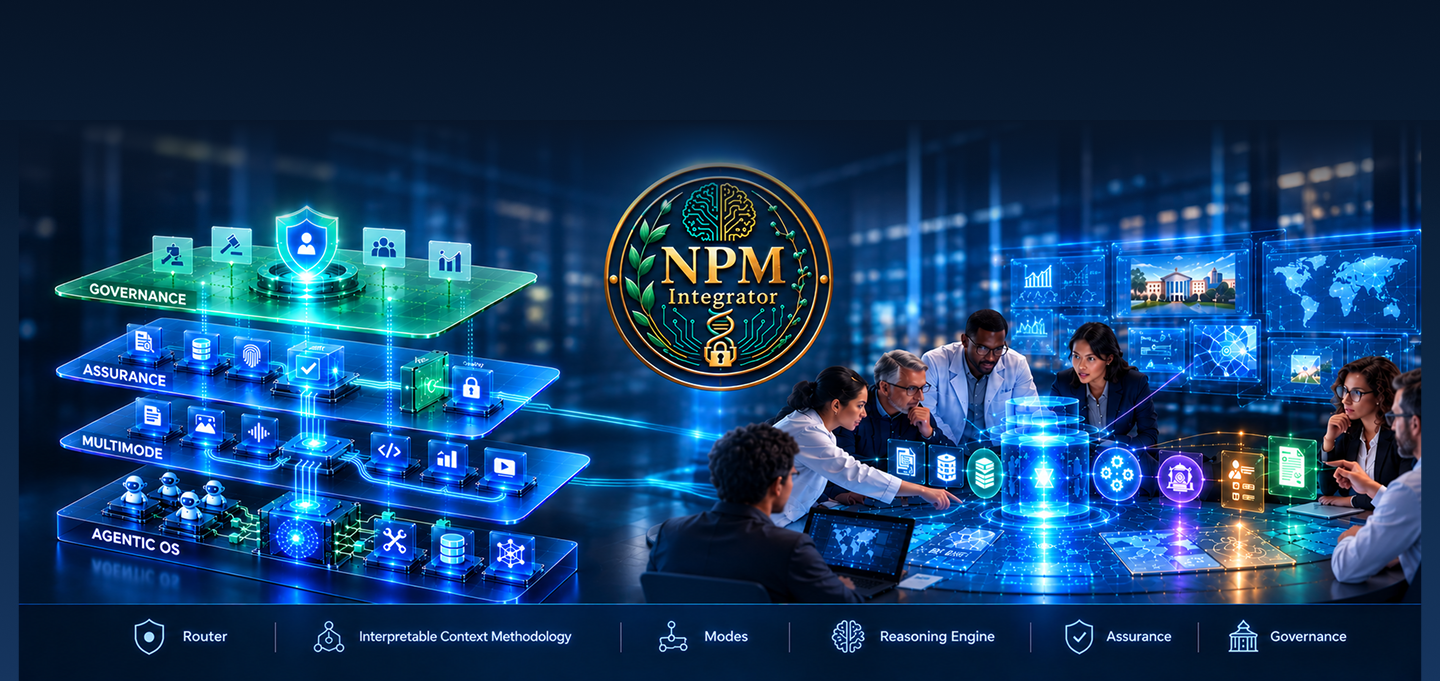
NPM Integrator is the shared scientific-intelligence and workflow-orchestration architecture connecting Cadenome’s education and research development.
It is designed to coordinate the work behind an application: understand the request, select permitted capabilities, supply the appropriate context, organize evidence-linked outputs and manage the path to review and release.
Request
What the architecture does
What the architecture does
Route the work
The NPM Router classifies a request’s purpose and risk, selects applicable modes and tools, checks dependencies and assembles a controlled execution plan.
A mode defines a specific capability—such as evidence appraisal, mechanism mapping or educational assessment—together with its required inputs, permitted sources, output requirements and review obligations.
Manage context through ICM
ICM—Interpretable Context Methodology—is the governed-context component of the architecture.
Its purpose is to keep the project’s scope, sources, instructions, permissions and relevant versions connected to the task being performed. The folder-and-file methodology makes these components inspectable and reusable, while authorized services—not folder names alone—must control access, execution and release.
Govern the relationship between claims and evidence
The evidence model is designed to connect scientific statements to identifiable sources and retain their limitations. Where a statement is an inference, hypothesis, traditional-use observation or unverified claim, that distinction should remain visible.
Governance does not make an unsupported statement true. Its role is to make support, uncertainty and review status inspectable.
A shared foundation for different applications
A shared foundation for different applications
The architecture is designed to support NPMEDU.ai, the wizard workflows, CIW and approved third-party applications without requiring every application to rebuild the same routing and evidence controls.
Shared technology does not mean unrestricted sharing of data or permissions. Education and research applications retain distinct purposes, access boundaries and release requirements.
Explore a technical collaboration
Explore a technical collaboration
We welcome discussions with developers and organizations seeking a governed reasoning and orchestration foundation for a defined application.
Potential engagements include application integration, specialized modes, institution-specific workflows and scoped technology-licensing discussions. Availability and implementation requirements are assessed against the relevant product release and project needs.